
This Land is Your Land: A Road Trip Through US History
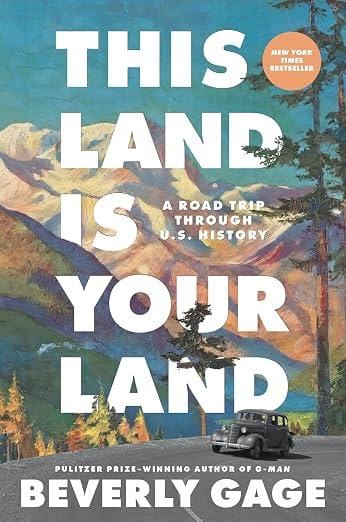
I was asking my sister, also an avid reader, what she had read and enjoyed recently. She mentioned this book by the Pulitzer Prize-winning historian, Beverley Gage. She said it reminded her of a trip we took around the US in our early teens, led by our father, an intrepid camper and history buff. Gage takes us on a historically chronological trip through some of the most important U.S. landmarks, from Philadelphia, the birthplace of our nation, to Disneyland
She explores the history of our 250-year-old country and its founding ideals, often showing us how we have failed to live up to them. Gage lets us face and acknowledge our country’s historical shortcomings while still celebrating the ideals that can and should keep us great.
I enjoyed revisiting some of the most famous historical sites in the U.S., like the Alamo and Mount Rushmore, as well as lesser-known but equally important sites, combining a personal road-trip narrative with in-depth historical context. Gage takes us to roadside attractions, museums, historical reenactments, and even souvenir shops!
One place I didn’t know much about was Chicago and the Gilded Age. George Pullman, the inventor of the Pullman railroad car, created a planned community to house his industry and its workers. According to Gage, “Pullman owned it all (part Utopian project and part savvy investment). In return for rent from his employees, he provided perks unavailable to the average Chicago worker: indoor plumbing, regular trash pickup, functioning sewers, interior skylights.” That all sounds good, until you realize that the workers had no autonomy or real freedom. Gage goes on to say, “On May 1, 1886, just two years after he completed his town, workers in a vast array of industries—steel, coal, rail, meatpacking—walked off the job in support of an eight-hour day. Newspapers dubbed it the Great Upheaval, predicting that class warfare—not industrial utopia—would define America’s future.”
Another interesting road trip took me to Dearborn, Michigan, home of the Ford Motor Company, which sold horseless carriages. Ford, with a mostly immigrant workforce, implemented a $5-a-day wage, nearly doubling his workers’ pay. “Despite the reputed benevolence of his $5-a-day wage, Ford maintained one of the country’s most aggressive security forces, notorious for spying on workers and, where necessary, shooting them if they engaged in protest. This led to the formation of the United Auto Workers Union (UAW). Gage went on to say, “The union in turn mounted a campaign to ‘Americanize Ford,’ arguing that industrial democracy—not corporate tyranny—was the true American tradition. The UAW made much of the fact that Ford accepted a medal from Hitler in 1938.”
Another site on Gage’s road trip is Manzanar, a World War II internment camp near Death Valley that housed over 10,000 Japanese-Americans. She writes, “Some internees tried to prove their loyalty by displaying American flags or singing patriotic anthems. Others took up the cultural trappings of American civic life: learning to twirl a baton, joining a Boy Scout troop. In classrooms, students were drilled in the virtues of the Constitution and the English language. But the irony was inescapable. ‘We are treated just like aliens,’ one resident explained on a panel inside a reconstructed Manzanar barracks. ‘So what’s the use of talking about citizenship and being loyal citizens?’”
Some of the similarities to today, where oligarchs rule industries much like they did in the Gilded Age, and people are rounded up and put in camps and prisons, are startling. But it can give us hope that America can grow, learn, and become better.
For a quick look, check out this recent video, “Judy Woodruff and Beverly Gage” on the PBS NewsHour.
Pick up her book at the County library and ride along for a trip through our nation’s history! You will learn things you were never taught in school.