
The 2018 California Values Act: Confronting Unjust Federal Immigration Enforcement
Part One: Background
Part Two of this article will be continued in the November 21 Newsletter.
The United States has struggled throughout its history to adopt and enforce reasonable immigration policies that affirm economic and humanitarian principles. Congress passed the first law to clarify who could apply for citizenship in 1790 (1). Nearly two centuries later, the Sanctuary Movement rose in response to questionable enforcement of the 1980 Refugee Act, and by 1985, more than 500 houses of worship across the country stood as public sanctuaries for Central American asylum seekers (2).
“The Constitution clearly specifies that every person in the United States has the right of due process,” as Project Director and Professor of Labor Studies for the UCLA Labor Center Victor Narro explained in a 2025 interview. “It doesn’t matter where you’re from, what you’ve done, what the government thinks you’ve done…. And that doesn’t just protect immigrants or people who might have broken the law, but also citizens (3).”
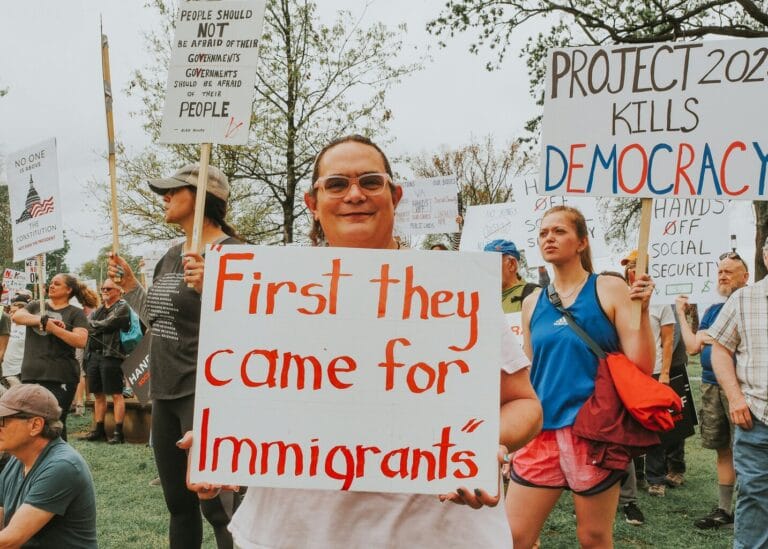
The legacy of the Sanctuary Movement lives on in the 2018 California Values Act (Senate Bill 54) that was passed in part due to President Trump’s 2017 Executive Order 13768. This executive order was intended to punish “declared sanctuary jurisdictions” by withholding federal grants, except as deemed necessary for law enforcement purposes. Fourth and Fifth Amendment rights were put in jeopardy, but the executive order was ultimately ruled unconstitutional and rescinded by President Biden in January 2021 (4). As said by the Associate Director of Resiliency Village, Alma Ibarra, the California Values Act “prevents local law enforcement from asking about immigration status, holding people for ICE, or sharing private information except in certain serious criminal cases, and provides clear rules that local and state agencies should not assist federal immigration enforcement except in limited, serious cases.”
Proponents argue that SB 54:
- Builds trust between the immigrant community and local agencies.
https://www.chhs.ca.gov/wp-content/uploads/2025/06/3.-Department-of-Justice-presentation-May-29-2025_ADA.pdf - Stops local law enforcement from asking people about their immigration status. https://www.thebulldog.law/senate-bill-54-the-california-values-act-sb-54
- Establishes safe spaces within California’s public institutions, such as schools, hospitals, courthouses, and libraries. https://www.thebulldog.law/senate-bill-54-the-california-values-act-sb-54
- Prevents state and local law enforcement from participating in federal immigration enforcement actions, which ensures that local law enforcement remains focused on community safety rather than engaging in federal immigration enforcement. https://www.aclunc.org/our-work/know-your-rights/know-your-rights-local-law-enforcement-and-immigration-under-california-0
- Reduces the chances of individuals being detained and deported solely based on their immigration status.
https://www.thebulldog.law/senate-bill-54-the-california-values-act-sb-54
Opponents argue that SB 54:
- Undermines the rule of law by not complying with federal immigration policies and authorities,
- Does not ensure the deportation of the immigrants who are criminals, and
- Affects the ability of local law enforcement to enforce laws effectively.
https://www.thebulldog.law/senate-bill-54-the-california-values-act-sb-54
What’s critical to understand in all of this is that our basic Constitutional rights are at stake without laws like SB 54. Podcast host Sonali Kohatkar emphasized the severity of the current national situation: “So if ICE comes and decides, based on whatever suspicion they have, without actually having a warrant, without actually determining whether the person that they are snatching up is undocumented or not, if they don’t give that person due process, that person could be anybody, including a citizen. And so if you don’t give due process to everybody, it essentially means nothing for anybody (3).”
Take Action
Take a deeper dive!
- “CA Values Act Bill Text,” California Legislative Information, October 5, 2017.
- “What is the 4th Amendment in your own words?” Legal Knowledge Base, June 25, 2022.
- “What is the 5th Amendment in my own words?” Legal Knowledge Base, October 29, 2023.
- “Resources for California’s Immigrant Communities,” Rob Bonta, Attorney General, State of California Department of Justice, 2025.
- Know Your Immigration Rights and Protections Under the Law
- Guidance for Immigrant Students and Families
- Protect Yourself from Immigration Scams
- Guidance and Model Policies for Public Institutions
- Resources for Employers
- File a Complaint
- Law Enforcement’s Responsibilities Under SB 54
- Defense Counsel and Prosecutors’ Responsibility Under Section 1016.3
NOTES
- “U.S. Immigration Timeline,” History.com, May 28, 2025.
- “The Sanctuary Movement,” California Migration Museum.
- Sonali Kohatkar, “CA’s Most LatinX City Adopts Strict Sanctuary Law.” Rising Up With Sonali podcast, July 16, 2025.
- “Executive Order 13768,” Wikipedia, September 18, 2025.