
Coming Soon to a Town Near Us: Polar Vortexes and Heat Domes

What are polar vortexes and heat domes, and why should we care? Understanding the causes and effects of extreme weather can inform our short and long-term decisions and preparations for ordinary life.
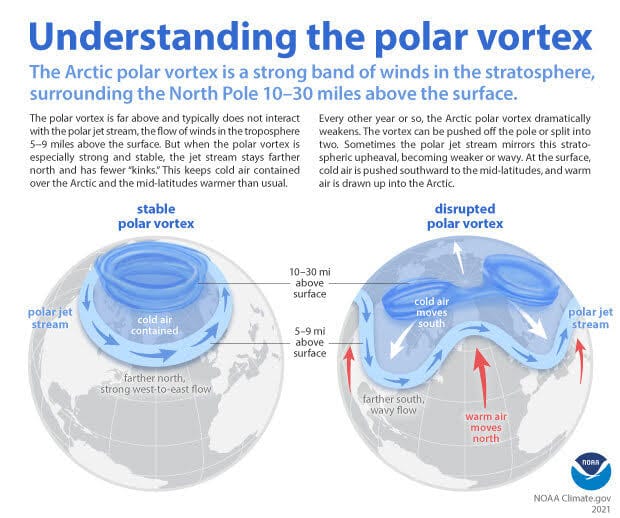
As our Earth spins, a crown of polar winds forms 10-15 miles above the Earth. Normally, this frigid air remains contained in this Arctic “vortex.” Concurrently, the jet stream circles the Earth, roughly along the latitude of the Canadian border. Less powerful, it moves east 5-10 miles above the Earth. It forms where cold air meets tropical warm air, moderating both temperatures. The difference between the cold and warm temperatures determines the jet stream’s speed and shape. During summer, tropical heat aided by the jet stream’s shape can be trapped in a “heat dome,” while the other side of the wave has cooler weather.
Increasingly important to our climate, the Arctic temperature is warming four times faster than the rest of the planet for several reasons:
- Man-made global warming,
- The North Pole warms as it leans toward the sun during summer,
- The naturally thinner atmosphere above the Arctic allows more of the sun’s heat to penetrate the atmosphere, and
- The polar sea ice sheet is melting at a faster rate, thus exposing more ocean. Rather than the ice sheet’s snow-white surface reflecting 90 percent of the sun’s rays, the dark ocean absorbs more of the sun’s heat, which in turn melts even more ice.
Concentrations of warm air in the Arctic can cause the polar vortex to become erratic, changing shape and sending polar air south. This disruption pierces and alters the jet stream’s shape into a dramatic wave that can retain its shape for weeks at a time. The result is a frigid “polar vortex” that reaches deep into America’s south. At the same time, tropical air fills the jet stream’s opposite wave, producing moderate winter weather elsewhere.
Temperature differences between warmer Arctic air and tropical air decrease, slowing the speed and strength of the jet stream. As a result, the jet stream loses some ability to moderate cold and warm climates. The more the Arctic warms, the more frequent and destructive polar vortexes and their counterparts, heat domes, become.
Tuolumne County residents are vulnerable to these shifting climate patterns and should already be preparing for dramatically warmer and colder temperatures. Texas has experienced temperatures 10 degrees above historic averages in a heat dome and 20 degrees colder during a polar vortex. Such temperatures may risk available energy resources and human life. Average world temperatures have risen 1.5 degrees Centigrade, endangering one-third of the world’s food production. Reduced production leads to higher food costs and desperate shortages. It is imperative for our Congressional representatives and other government leaders to understand global warming.
Take Action
- For information on preparing for cold weather extremes, visit: https://www.weather.gov/safety/cold-before
- Visit: https://www.ready.gov/heat to learn about preparing for extreme heat.
- Support the Red Cross as a donor or a volunteer.
- Join or start a Firewise neighborhood group.
- Join a Community Emergency Response Team (CERT) in Twain Harte, Groveland, Me-Wuk Tribal, Columbia Area, or Tuolumne County.
NOTES
1. Rebecca Lindsey, “Understanding the Arctic Polar Vortex,” NOAA Climate.gov, March 5, 2021.
2. Sara Heikonen, Matias Heino, Mika Jalava, Stefan Siebert, Daniel Viviroli, and Matti Kummu; “Climate Change Threatens Crop Diversity at Low Latitudes,” Nature Food, March 4, 2005.