
Our Natural Reservoirs: Snowpacks
About 30 percent of our annual average water supply comes from snowpack (1). The last two years’ worth of rain and snow filled our reservoirs. We couldn’t add any more water without risking the reservoirs’ role in holding back unanticipated large storm waters that could lead to flooding.
But this year’s snowpack illustrates a nagging problem. With adequate reserves, things looked good, and the snowmelt was expected to supplement our reservoirs. Then came the hottest March temperatures ever recorded. Reserves melted early and flowed into the Pacific Ocean.
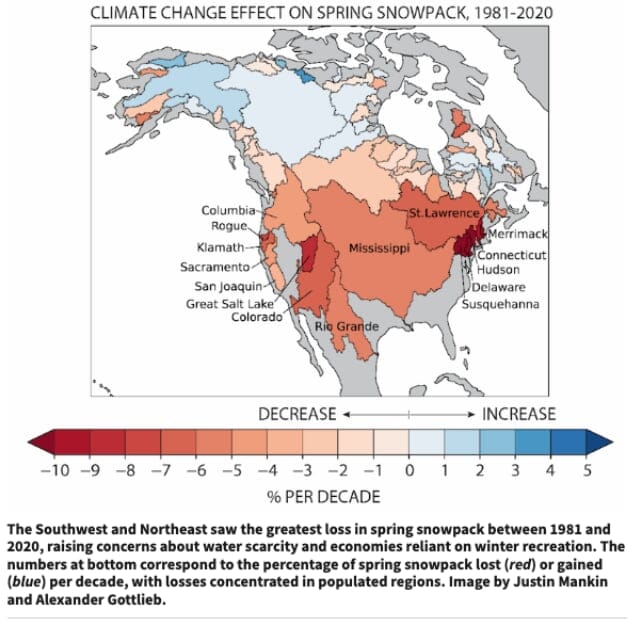
A warming climate is decimating our snowpacks. Dartmouth researchers Alexander Gottlieb and Justin Mankin report in the journal Nature that the extent and speed of this loss could put hundreds of millions of people, who depend on snow as their water source in North America, Europe, and Asia, on the brink of a crisis that continued warming will worsen. “Our work identifies the watersheds that have experienced historical snow loss, and those that will be most vulnerable to rapid snowpack declines with further warming,” Gottlieb said. “The train has left the station for regions such as the Southwestern and Northeastern United States. By the end of the 21st century, we expect these places to be close to snow-free by the end of March. We’re on that path and not particularly well adapted when it comes to water scarcity (2).”
Today, we can’t rely on snowpacks to provide water through the summer. Along with declining Sierra snowpacks, Rocky Mountain snowpacks are also declining, and they charge the Colorado River, reservoirs, and dams. Warmer winters have meant more rain instead of snow.
The Southwest is already in drought. For a broader discussion of the problems warming is creating in the Southwest, see PBS News Horizons: “As the Colorado River dries up, how Western states are confronting the water crisis” (3).
The graph below depicts the rate of snowpack loss per decade (4).
The West is warming and drying, and California is no exception. From 1970 to 2015, global temperature increased by 0.02 degrees Celsius, and since 2015 it has nearly doubled to 0.35 degrees Celsius (5). Inaction on climate change will expose us to unrelenting warming we cannot compensate for—loss of snowpack, drought, wildfires, and massive atmospheric rivers that increasingly threaten Tuolumne County with flooding. And yet, global warming remains near the bottom of national political concerns. Our Congressman, Tom McClintock, proudly supports climate denial.
Confronting global warming means changing our energy sources from oil and gas to wind and solar. We need to use America’s energy and water supplies far more wisely. We should demand action from our government and use our purchasing power and votes to pressure corporate and political leaders.
Take Action
- Conserve water: Take shorter showers, fix leaks, and use water-efficient appliances to reduce water waste.
- Reduce greenhouse gas emissions: Drive less, carpool, bike, or use public transportation to help slow climate change, which causes warmer temperatures and faster snowmelt.
- Plant trees: Plant and protect trees to support healthy mountain ecosystems and help maintain natural habitats.
- Reduce pollution: Reduce waste, recycle, and avoid burning trash to help keep the environment clean.
- Save energy: Turn off lights when not in use and use energy-efficient appliances to reduce emissions from electricity production.
- Protect forests: Support forest conservation efforts and avoid activities that can damage mountain habitats.
- Educate others: Teach friends, family, and community members about the importance of mountain snowpacks and how climate change affects them.
- Support clean energy: Encourage the use of renewable energy sources, such as solar and wind power, to reduce greenhouse gas emissions.
- Reduce waste: Reuse items, recycle materials, and avoid single-use plastics to reduce pollution and conserve resources.
- Support environmental programs: Participate in local conservation projects and support policies and programs that address climate change and protect mountain environments.
NOTES
- “February Storms Provide a Much-Needed Boost, but Statewide Snowpack Remains Below Average,” California Department of Water Resources, February 27, 2026.
- Alexander Gottlieb and Justin Mankin, “Evidence of human influence on Northern Hemisphere snow loss,” Nature, January 10, 2024.
- “As the Colorado River dries up, how Western states are confronting the water crisis,” PBS News Horizons, May 15, 2021.
- Morgan Kelly, “Changing Climate Behind Sharp Drop in Snowpack Since 1980’s,” Drought.gov, National Integrated Drought Information System, NOAA, January 24, 2024.
- “Global Warming is Accelerating, Study Shows,” Yale Environmental 360, Yale School of the Environment, March 9, 2026.