
Is Climate Change a Future Problem?

Some people think the impact of climate change won’t confront us until sometime in the future. Yet global warming started with the First Industrial Revolution around 1760. If you were to look backward at a temperature timeline from 1980 to 1760, you would think the progress of warming isn’t bad. But looking forward from 1980 to the present, you should be startled to see how quickly climate change has accelerated as humans use more energy.
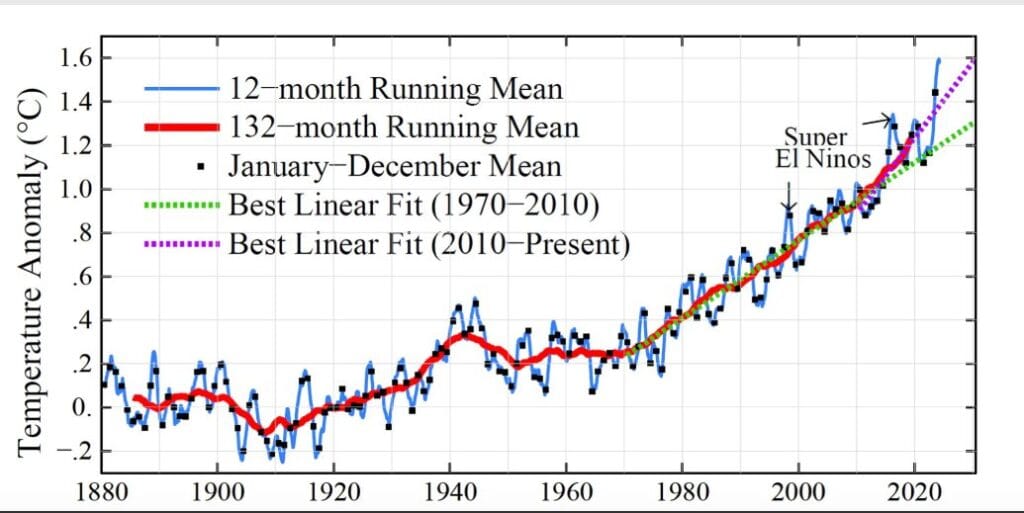
Climate change is happening faster than even climate scientists thought possible. It’s like sitting in a car going 70 miles per hour while wearing a blindfold. It may be difficult to discern if the vehicle is moving–that’s akin to saying, “climate change isn’t happening.” What then explains why U.S. wildfires are four times larger, three times more frequent since 2000? In addition, why has our fire insurance increased exponentially or been canceled?
Consider a couple of recent climate-related disasters. The Los Angeles wildfires, costing an estimated $40 billion, were driven by 90 mph winds that gusted over 100 mph. Nothing normal about that. On one day in mid-March 2025, 660 tornadoes killed nearly 50 people in the Midwestern U.S. There is nothing normal about 660 tornadoes in one day.
Why are these disasters occurring? Because humanity is polluting our atmosphere with CO2 from burning fossil fuels and releasing methane through leaking production and distribution facilities. And now, methane is being released from once frozen Arctic peat bogs, melting in a warming climate. Together, these cause a blanket of pollution to form in the atmosphere that limits the Earth’s ability to reflect heat into space. The more we pollute, the more we heat our planet.
Consider this analogy: the planet Venus is 72 million miles from the sun, and Mercury is 36 million miles from the sun, yet both have nearly the same daytime temperature. The difference is that even though Venus is twice as distant, its atmospheric blanket holds in more heat. Earth’s atmosphere allows for all types of life, but unchecked pollution will heat our atmosphere until it is unbearable. It’s up to us.
Why haven’t we stopped burning fossil fuels? Last year, the American oil and gas industry made $200 billion from product sales. Although they know their products cause global warming, they protect future profits by distributing false information about it. Examples include promoting that “climate change is a future problem.” Scientists don’t have the funds to compete for the public’s attention with facts. In addition, politicians need money to win elections and get much of it from the oil industry in exchange for adopting the industry’s agenda.
A quick way to get caught up on the basic realities of climate change is by watching a 15-minute TED talk given by James Hansen, a prominent NASA climate scientist. This is a straightforward, plainspoken explanation of global warming.
Take Action
- Reduce how much we consume, which will put less stress on the planet.
- Reduce plastic. Plastic is made from oil, and the process of extracting, refining, and turning oil into plastic (or even polyester, for clothing) is carbon intensive.
- Reduce our consumption of meat and dairy by lowering greenhouse gas emissions, particularly methane and carbon dioxide, from animal agriculture.
- Help keep our homes comfortable during extreme weather by insulating walls and roofs and switching away from oil or gas boilers to heat pumps.
- Buy from our local farmers.
- Write a letter to the editor about what you learned by reading the articles listed in this article’s NOTES.
NOTES
1. Virginia Iglesias, Earth Lab research scientist, “U.S. fires four times larger, three times more frequent since 2000,” Cooperative Institute for Research in Environmental Sciences (CIRES), University of Colorado Boulder, March 15, 2022.
2. James Hansen, Pushker Kharecha, Makiko Sato, etc., “Global Warming Has Accelerated: Are the United Nations and Public Well-Informed?” Environment: Science and Policy for Sustainable Development, Informa UK Limited, February 3, 2025.
3. “Oil and Gas PACs contributions to candidates 2023-2024,” Open Secrets, 2025. (Based on data released by the Federal Election Commission on February 6, 2025.)
4. “What are the Solutions to Climate Change?” Greenpeace, Greenpeace UK Ltd.