
Dry Hydrants and Raw Water: A Lifeline for Tuolumne County When Facing Wildfires
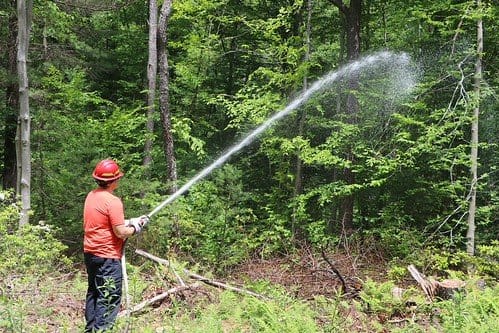
As a former Tuolumne Utility District (TUD) director, a long-time TUD irrigation ditch customer (even before TUD existed), and someone who worked in the post-fire moonscape of the Stanislaus Complex Fire of ’87, I know the threat of fire in Tuolumne County is very real, and that water is very precious. When I compare Tuolumne County to other rural communities like Paradise, whose water infrastructure and economy were destroyed by fire, I see how fortunate we are to have kept the ditch and reservoir system flowing throughout our county.
We have what the gold miners engineered 175 years ago, and what has now become a critical infrastructure for our emergency response to wildfire. Unlike sporadic fire hydrants with expensive pressurized treated water, our localized ditch-fed reservoir water is immediately and abundantly available. And it’s the cheapest water to use on a fire. The San Diego Reservoir at Columbia College holds 13 million gallons of water, for example, and has a dedicated, accessible dry hydrant that stands ready to use in case of fire.
People erroneously think we have an unlimited supply of pressurized treated water behind each fire hydrant – like Modesto – dedicated to fire flow. The truth is that we only have what’s stored in the tanks. The TUD tanks around the county store treated drinking water. Treated water is expensive water. Though it benefits the entire community for fire suppression, it is paid for by TUD ratepayers, only about 80 percent of County residents. The County needs to be aware of this benefit.
If the tanks lose pressure during the fire, we’re in trouble. One fully engulfed structure can take between 2,000 and 15,000 gallons of water to put out. One 50,000-gallon tank can bleed out in less than 5 hours. Fortunately, we have a dual water system here: our treated water system and our gravity-fed raw ditch system.
This is why TUD is learning a serious lesson from the Camp Fire in Paradise and maintaining our ditch and reservoir system for fire-water drafting points before we burn. The 2018 Camp Fire’s post-fire report, Paradise Nature-Based Fire Resilience Project Report, recommended incorporating greenbelts and green linkages like parks, orchards, ditch systems, and creeks into the communities. Greenbelts and hydrated landscapes can reduce fire intensity and fire spread.
In 2023, TUD received a USDA grant to assess high-intensity fire zones in relation to its infrastructure, inventory biological resources along the ditch systems, and identify fire-water drafting point locations along the 70 miles of the gravity-fed ditch. Over 50 fire-water access points were identified and recommended for development.
It makes sense for TUD and the County to recognize the value and realities of living in a watershed and that our ditch water system is knitted into it. Drying up the ditches and creating an enormous fuel load, making it harder and harder to get fire insurance, is not the answer. Clearly, making the ditch water available at access points for fire and keeping them as greenbelts with hydrated vegetation and soil is the greater benefit.
Turning Phoenix Lake into a shallow marsh is not an answer. Rather, it would help the TUD ratepayer, not to mention the whole community, if the County stepped up and helped reduce upstream sediment sources that are silting in the Lake. TUD must also make a concerted effort to keep finding grant money for dredging. At 276 million gallons (could be less now), Phoenix Lake is the largest water impoundment west of the PG&E flume, and our public water agency (TUD) owns it. Again, the reality is we live in a watershed. The most efficient thing to do is work with nature; not fight it, pipe it, or straighten it, but find nature-based solutions.
We are not Modesto. We are not solely dependent on pipes and pumps. But we owe it to our community to recognize the enormous non-consumptive benefits of our water. It is not just a money-making commodity, but a force of nature our children should have greater access to. It makes sense for the County, City, and TUD to work together to pursue state grant money to develop fire-water access points along the ditch, manage the ditch system as a greenbelt, and increase Phoenix Lake’s capacity for water reliability and community resiliency before we burn.
Take Action
- Attend TUD Board meetings, which are the 2nd and 4th Tuesday, 9-11 a.m. at the TUD Office, 18885 Nugget Blvd, Sonora.
- Read TUD’s Wildfire Defense Plan (or just parts of it).
- Read about dry hydrants and their important use.