
Big Beautiful Vouchers for Private Schools, But What About Public Schools?

Should public funds be available to support attendance at private schools? Following the lead of many states over the last decade, Congress answered this question by incorporating parts of a proposed Senate measure, the Educational Choice for Children Act, into the federal budget reconciliation bill signed on July 4. The rider establishes the first federal school voucher program through an income tax credit for annual donations up to $1,700 to Scholarship Granting Organizations (SGOs).
Acting as intermediaries, SGOs must be qualified nonprofits, allotting less than ten percent of revenue to administrative costs. They aggregate donations from individuals, corporations, foundations, and businesses, then award scholarships as tuition assistance according to policies developed under established parameters (1).
The federal school voucher program becomes effective January 1, 2027, and requires a governor to opt in. Thirty states and the District of Columbia already have at least one private school choice program, according to an Education Week analysis (2). These programs range from education savings accounts to direct tax credits and vouchers. While California does not have a state-funded voucher program, public school choice options include charter and magnet schools, open enrollment, and District of Choice programs in specific school districts.
The National Education Association (NEA) estimates the federal voucher program will redirect at least $25 billion in tax revenue in its first year. The map below shows existing state voucher programs, which may vary from each other and the federal model (3).
| States with universal school voucher programs (available to all, regardless of income) | ||
| States with limited school voucher programs (has parameters such as income or disability) | ||
| States with no voucher programs |
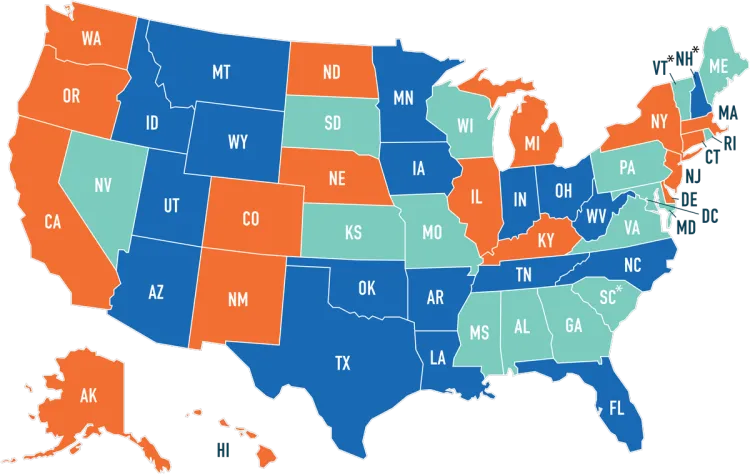
Critics of voucher programs claim this massive transfer of funding will harm the most vulnerable members of our community.
- Public schools. As students leave public schools for private ones, enrollment-based reimbursements will decrease with no corresponding reduction in fixed costs, increasing the cost per pupil. The Learning Policy Institute calculates that a five percent decrease in enrollment at Sonora High School would reduce per-pupil funding by $475 (4).
- Low-income families who cannot afford the $900-$2,500 tuition balance not covered by vouchers will be stranded in impoverished public schools (5).
- People dependent on critical taxpayer-funded programs may experience reductions in services as a result of huge voucher cost overruns, just as Arizonans did when they underestimated the cost of their voucher program by tenfold (6).
- Students requiring additional services or protections.
- Private schools are not required to:
- admit or retain students who don’t meet the school’s academic requirements or who require additional expensive services (7), or
- follow the Individuals with Disabilities Education Act (IDEA), which prohibits discrimination against students with disabilities (8).
- Private schools are not required to:
- Religious schools are exempt from Civil Rights legislation regarding enrollment and acceptance of students based on their religion (9).
- Students participating in large voucher programs. Recent studies show clear negative effects on student test scores in places where vouchers have expanded into large programs, such as Louisiana, Indiana, Ohio, and Washington D.C. (9, 10).
The NEA and other advocacy organizations won the following changes to the federal voucher program during the legislative process:
- States can choose to opt out of the voucher program.
- Schools receiving voucher funds will be subject to federal regulations that may be supplemented by the state (11).
Maximum tax credits were also restricted under the federal legislation as compared to the original Educational Choice for Children Act.
Take Action
1. Contact the governor’s office at https://www.gov.ca.gov/contact/ to advocate for the following mitigation actions:
- DO NOT opt into the voucher program.
- If California DOES opt into the program, ensure private schools are held accountable (5).
- Require strict accounting and transparency in taxpayer-funded voucher programs.
- Regulate voucher programs to guarantee private school students the same First Amendment freedoms, due process, and other constitutional and statutory rights guaranteed in public schools (12).
2. Contact your state assembly member and state senator. For contact information, see the Government Info section of this website:
3. Develop a teacher and parent group to advocate at school board meetings and at the state hearings on the private school vouchers.
NOTES
- Joseph Weinberger, “Scholarship Granting Organizations: A New Era of Educational Choice with OBBBA,” The Bonadio Group, July 22, 2025.
- Mark Lieberman, Libby Stanford & Victoria A. Ifatusin, “Which States Have Private School Choice?” Education Week, Updated June 11, 2025.
- Amanda Litvinov, “The Price We Pay for Vouchers,” NEAToday, July 31, 2025.
- Hilary Wething, “How Vouchers Harm Public Schools/Fiscal Externality Calculator,” Economic Policy Institute, December 19, 2024.
- Weadè James and Tania Otero Martinez, “Introducing a Framework for Private School Voucher Accountability,” Center for American Progress, April 8, 2025.
- Eli Hager, “School Vouchers Were Supposed to Save Taxpayer Money. Instead They Blew a Massive Hole in Arizona’s Budget,” ProPublica, July 16, 2024.
- “Myths and Facts About Vouchers,” The Education Justice Research and Organizing Collaborative, NYU Steinhardt, 2025.
- Diane Ravitch, “Texas: Beware of Vouchers!” Diane Ravitch’s Blog, National Education Policy Center, April 14, 2025.
- Joshua Cowen, “Apples to outcomes? Revisiting the achievement v. attainment differences in school voucher studies,” Brookings, Revised February 2024.
- Kevin Carey, “Dismal Voucher Results Surprise Researchers as DeVos Era Begins,” The Upshot, NY Times, February 23, 2017.
- Amanda Litvinov, “Trump’s Budget Bill: An Attack on Public Schools, Working Families, and Immigrants,” NEAToday, July 7, 2025.
- “Vouchers Undermine Civil Rights,” National Coalition for Public Education.